

Hi, I’m Bonnie Marcus. Welcome to Own Your Ambition, a weekly newsletter where I offer my best advice on how to successfully navigate the workplace as a woman today. A former CEO who made it to the C Suite from an entry level, executive coach and published author, I share my experiences and lessons learned from my tenure in corporate, focusing on giving women proven tools and strategies.
This week, I’m in conversation with bestselling author and executive coach, Dr. Lois Frankel, on the new edition of Nice Girls Don’t Get the Corner Office. As always, she offers sound coaching advice and a valuable perspective on women in the workplace today.

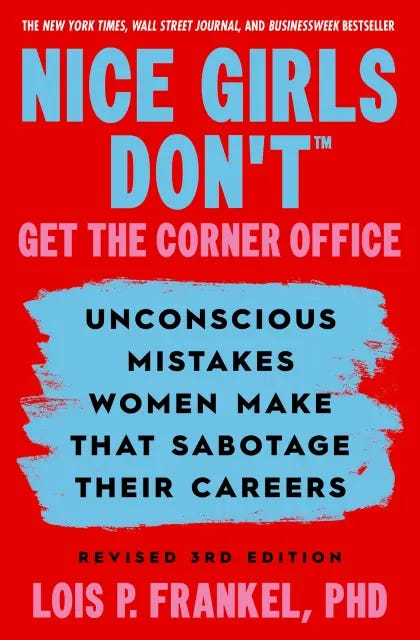
Dr. Lois Frankel, an internationally recognized expert in the fields of workplace behaviour and female empowerment, and the president of Corporate Coaching International, launches the newest edition of her groundbreaking book, Nice Girls Don’t Get the Corner Office, this week—a title that has shaped the career conversations of professional women for more than a decade.
We focused our discussion on women’s leadership in the workplace, the opportunities, challenges, and future.
Our first exchange highlighted why women’s leadership matters now.
“We currently live in a bro-ocracy. It is almost entirely white men who are making the rules for the rest of us in society.”
As a result, we are seeing an erosion of civility, respect for differences, and decision-making that capitalizes on diverse viewpoints—all things that women bring to the leadership table.”
This is not about women being “better.” It’s about women being different—and that difference being exactly what the world needs.
“Women don’t make better leaders than men, they make different leaders—and that difference is precisely what we need today if we have any hope of healing the damage being done in society.”
“It will be women who bring the world more balance.”
Leadership is a woman’s art. And we’ve been practicing it all along.
Why So Many Women Still Hesitate to Lead
Despite women leading in homes, communities, nonprofits, and corporations every day, many still hesitate to claim formal leadership roles. Why?
Dr. Frankel points to five core reasons.
First: fear of humiliation.
“Being called out and embarrassed by men who are threatened by their potential power to flip the script.”
Second: lack of visible role models.
“If you see it, you can be it.”
Third: misunderstanding what leadership actually is.
Too many women still measure themselves against an outdated, hyper-masculine model of power—command-and-control, dominance over dialogue.
Fourth: open hostility.
“Resentment comes not only from men but from other women.”
And fifth: the chronic experience of having ideas criticized rather than built upon.
When every contribution feels like a battle, silence can feel safer.
But silence comes at a cost.
Ways Women Hold Themselves Back
Dr. Frankel addresses the subtle ways women undermine their own influence.
“Every time a woman hesitates to speak her mind or speak truth to power, she misses out on an opportunity to influence outcomes.”
When she defers to louder voices?
“Her confidence diminishes.”
When she declines to step into new leadership because she doesn’t feel 100% ready?
“She is overlooked for future leadership opportunities.”
How can women own their ambition?
Frankel offers three bold directives:
1. Take more risks.
“Whether it’s the risk of speaking up or volunteering for a high-profile role, do it.”
You owe it to yourself. And you owe it to the women and girls watching you.
2. Ask for what you want.
“Don’t wait to be noticed. Just the act of asking demonstrates leadership.”
Political savvy begins with self-advocacy.
3. Focus on acquiring wealth.
This one stops women in their tracks.
“Don’t settle for surviving when thriving should be your goal.”
Money is not greed. It’s freedom. It’s leverage. It’s optionality.
“Money in the bank provides you with the freedom and confidence to take risks and ask for what you want.”
Leadership without economic power is fragile. Leadership with financial independence is formidable.
The Workplace Is Shifting—And Not in Women’s Favor
Dr. Frankel addresses the current workplace climate.
“For women, the greatest workplace challenge today is the erosion of DEI efforts.”
Diversity initiatives didn’t hand women advantage, they created access.
“It’s not that these programs gave women a step up, but it lent them a hand up.”
The rapid dismantling of these efforts reveals how shallow institutional commitment often was.
So what now?
“Now it’s time for women to support each other at all levels.”
Her prescription is practical and powerful:
Start women’s discussion groups.
Mentor deliberately.
Hire women without fear.
Build informal power networks.
“We are so much stronger together than individually.”
Then there’s remote work—a double-edged sword.
“Working from home is not a panacea for women. It’s far from it.”
Without boundaries, work bleeds into caregiving. The invisible load expands.
The antidote?
“Set boundaries and ask for help.”
In the 2026 edition of Nice Girls Don’t Get the Corner Office, she devotes an entire chapter to navigating remote work strategically, without sacrificing visibility or advancement.
Women Lead All the Time. They Just Don’t Call It Leadership.
This may be Dr. Frankel’s most important point.
“If you believe as I do that leaders take people to places they would not or could not go alone, then you know that women are superb at this.”
Leadership doesn’t require a title.
The woman who chairs a nonprofit fundraiser using strategy, influence, and financial acumen? Leader.
The employee who heads a task force to increase productivity through research and relationship-building? Leader.
The executive assistant who ensures the right people are in the right place with the right information? Leader.
Women often practice leadership in relational, operational, and strategic ways—yet discount it because it doesn’t look like the stereotypical CEO model.
Leadership is not a corner office. It is impact.
Gravitas: The Missing Link
When I asked Dr. Frankel about gravitas, she referenced Sylvia Ann Hewlett and her book Executive Presence.
“Gravitas is the non-technical ways in which we communicate our ability to lead.”
It’s not about competence alone. It’s about how competence is conveyed.
Frankel advises women to:
Communicate crisply and succinctly (harder than it sounds).
Speak truth to power.
Dress for the role.
Exhibit grace under pressure.
And she recommends studying women who embody it:
Margaret Thatcher
Angela Merkel
Kamala Harris
Julia Gillard
Coretta Scott King
Different styles. Different ideologies. Same unmistakable presence.
Gravitas is not mimicry of masculine power. It is disciplined self-possession.
Leadership Is a Woman’s Art
If leadership is about taking people where they could not go alone, women have been doing it for centuries—in homes, movements, classrooms, communities, and corporations.
But now we must name it. Claim it. Expand it.
We are living in a moment where civility feels fragile, institutions feel unstable, and power feels concentrated in too few hands.
Dr. Frankel’s message is an invitation.
Women do not need to become more like men to lead.
They need to:
Take risks.
Ask directly.
Build wealth.
Support each other.
Communicate with gravitas.
And stop waiting for permission.
The updated Nice Girls Don’t Get the Corner Office is not as a polite career manual—but as a strategic playbook for women who are done shrinking.
Because leadership isn’t about occupying the corner office.
It’s about reshaping the room.
And that—now more than ever—is a woman’s art.
I really appreciate how you hold the nuance here: women don’t need to be “nicer,” and they also don’t need to contort themselves into a caricature of masculine power to be taken seriously.
With the high‑achieving women I support, the cost of that contortion often shows up first in their bodies — anxiety, burnout, hormone and sleep disruption from constantly self‑monitoring how loud, direct, or ambitious they’re allowed to be. Framing risk‑taking, wealth‑building, and gravitas as skills women can claim **without** abandoning their relational, emotionally intelligent way of leading feels like a genuine path forward, not just another performance script.
Your title is so expansive.
The word nice- attached to women- is a tepid compliment that means nothing. Nice doesn't imply strength
Nice pinches women into being a feminine version of what is societally palatable.
Women can be kind and compassionate while being clear, concise and in command.